
 |
 |
 |
 |
|
Epidermal Growth Factor Advanced gut support for improved intestinal health and performance |
|
What is EGF? Epidermal Growth Factor (EGF) is a 53-amino-acid polypeptide that drives cell growth, proliferation, and differentiation by binding to its receptor EGFR — one of the most conserved and critical signaling pathways in vertebrate biology. In healthy animals, EGF is naturally supplied through multiple endogenous sources: salivary glands, Brunner's glands of the duodenum, and — critically for neonates — maternal colostrum and milk. These sources ensure the developing gut receives continuous EGF signaling during its most vulnerable growth window. Under intensive farming conditions, this supply is disrupted. Early weaning removes the colostrum source before the gut is fully developed. High-density housing and chronic stress reduce salivary and glandular secretion. The result: a significant EGF deficit precisely when the gut needs it most — creating the foundation for poor intestinal development, increased permeability, and vulnerability to enteric disease. Learn more about EGF and EGFR signaling |
 |
|
Why do Animals Need EGF? |
| Scenario 1 — Early Life Development In neonatal animals — weaned piglets, day-old chicks, newborn calves — the gastrointestinal tract is structurally immature. EGF signaling is the primary driver of villus elongation, crypt proliferation, and enterocyte differentiation during this window. Research has shown that dietary EGF supplementation in weaned piglets significantly increases villus height and villus-to-crypt depth ratio, while activating the mTOR signaling pathway that governs epithelial cell proliferation. (Ref: Sun et al., 2019, Science China Life Sciences) |
 |
 |
Scenario 2 — Stress & Disease Recovery Intestinal injury from pathogens, mycotoxins, or physiological stress disrupts the epithelial barrier — increasing permeability, triggering inflammation, and impairing nutrient absorption. Exogenous EGF activates repair by stimulating tight junction protein expression and promoting epithelial restitution. In ETEC-challenged piglets, EGF supplementation reduced oxidative stress markers and supported improved feed efficiency during recovery. (Ref: Canadian Journal of Animal Science, 2021) |
| What can EGF bring You? |
| Accelerate Intestinal Development EGF binds to EGFR on intestinal epithelial cells, activating proliferation and differentiation signals that drive villus elongation and crypt development. This is especially critical in neonatal and post-weaning animals, where gut structural maturity directly determines feed utilization efficiency and disease resistance |
 Accelerate Intestinal Development Accelerate Intestinal Development |
 Improve Feed Conversion Improve Feed Conversion |
Improve Feed Conversion |
| Strengthen the Mucosal Immune Barrier EGF upregulates tight junction protein expression, reducing intestinal permeability and limiting pathogen translocation across the epithelium. By rebuilding the structural foundation of mucosal immunity, EGF reduces the colonization of enteric pathogens and decreases the frequency and severity of gut-related disease events. |
 Strengthen the Mucosal Immune Barrier |
| Species | Key Application Window | Primary Benefit |
| Swine | Weaning transition (D21–D42) | Villus recovery, diarrhea reduction, FCR improvement |
| Broiler | Day 1–14 (gut establishment) | Early gut maturation, improved uniformity |
| Laying Hens | Peak production & molt recovery | Gut integrity maintenance, feed efficiency |
| Ruminant | Calf early life & diarrhea recovery | Mucosal repair, barrier restoration |
| Aquaculture | Post-stocking stress & disease challenge | Mucosal fold development, pathogen resistance |
| Explore Tipek for your species |

|
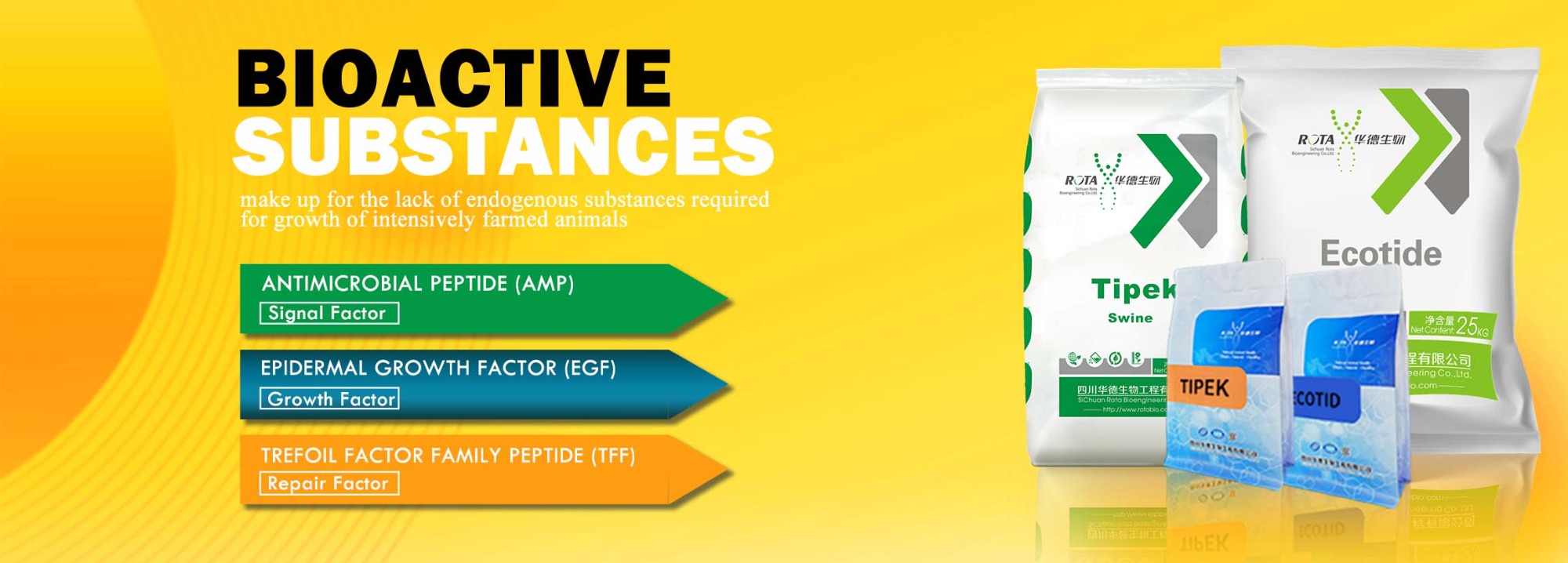
Huade's Tipek series delivers species-specific recombinant EGF — including recombinant Gallus EGF for poultry — in formulations matched to the EGF receptor profile and gut development timeline of each species. |


